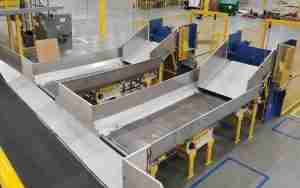











May 15, 2023 • Horizon Industrial

Recent Conveyor

Projects

From new conveyor installations to emergency repairs and full facility relocations, Horizon Industrial delivers projects that keep Western Canada’s distribution centres, fulfilment hubs, and food and manufacturing facilities running. Red Seal millwrights. PMP-certified project management. Emergency response.

Emergency Response

Get a Free Quote

Amazon
Walmart
FedEx
DHL
UPS
TJX Canada
Staples
Sobeys Voila
DB Schenker
Ocado
Old Dutch
Fortna
Amazon
Walmart
FedEx
DHL
UPS
TJX Canada
Staples
Sobeys Voila
DB Schenker
Ocado
Old Dutch
Fortna

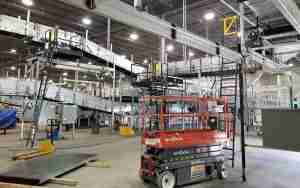
Conveyor Care Fundamentals: A Millwright Maintenance Guide

Conveyor care fundamentals encompass four core disciplines: belt tension management, roller and bearing inspection, lubrication scheduling, and component troubleshooting. Proper belt tension prevents tracking issues and premature wear—most systems require 1-2% elongation at operating load. Roller inspections should occur weekly in high-volume facilities, checking for bearing noise, surface wear, and alignment. This guide provides actionable protocols used in Western Canadian distribution centers.

View Project »

Conveyor Belt Damage Assessment: Restore or Replace

Belt damage assessment follows a systematic evaluation process: identify the damage type (edge wear, surface cuts, splice failure, or belt tracking issues), measure the affected area, and determine structural integrity. Minor surface damage under 25% belt thickness can often be restored through hot or cold vulcanization. Splice failures typically require professional re-splicing with proper tensioning. This guide helps facility managers distinguish between repairable damage and situations requiring full belt replacement.

View Project »

Conveyor Project Management: Timelines and Coordination

Conveyor project management requires structured phase planning across five stages: scope definition, procurement scheduling, site preparation, deployment execution, and commissioning validation. Successful projects establish clear milestones—typically 2-3 weeks for procurement, 1-2 weeks for site prep, and 3-6 weeks for deployment depending on system complexity. Risk mitigation includes buffer scheduling for custom component lead times and coordination protocols for multi-trade installations. This guide covers best practices used in Western Canadian warehouse and distribution center projects.

View Project »

Conveyor Project Budgeting: What Drives the Total

Conveyor budgeting requires accounting for five cost categories: equipment procurement (40-60% of total), professional labor (20-35%), site preparation and electrical (10-20%), commissioning and testing (5-10%), and contingency reserves (10-15%). Equipment costs vary significantly by conveyor type—belt conveyors average $200-500 per linear foot, while sortation systems range $800-2,000. Labor rates in Western Canada average $85-150 per hour for specialized trades. This guide provides realistic budget frameworks based on actual Alberta and BC project data.

View Project »

Conveyor Types Explained: Belt, Roller, Chain and Sortation

Conveyor types serve distinct operational requirements based on product characteristics, throughput demands, and facility constraints. Belt conveyors handle irregular items and inclines up to 30 degrees. Roller conveyors excel with flat-bottomed products requiring accumulation zones. Chain conveyors manage heavy loads exceeding 500 lbs per linear foot. Sortation systems process 100-400+ packages per minute for high-volume distribution. This comparison guide helps facility managers select the optimal conveyor type based on application requirements, space availability, and budget parameters.

View Project »